


Your shopping cart is empty!
Watermelon “Melitopolsky”
Eco seeds
New
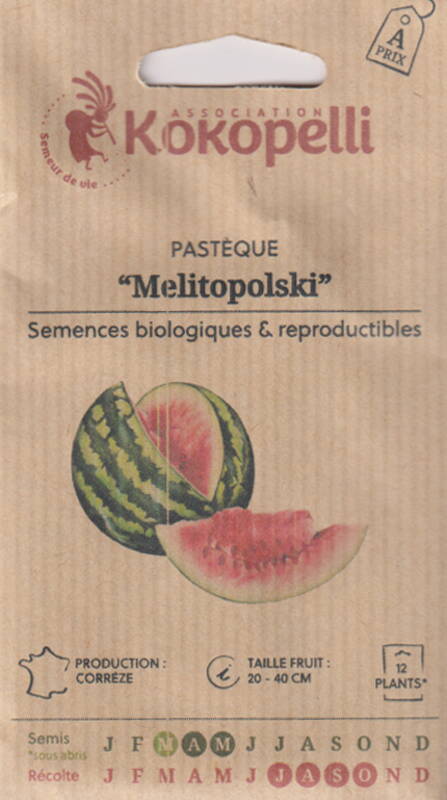
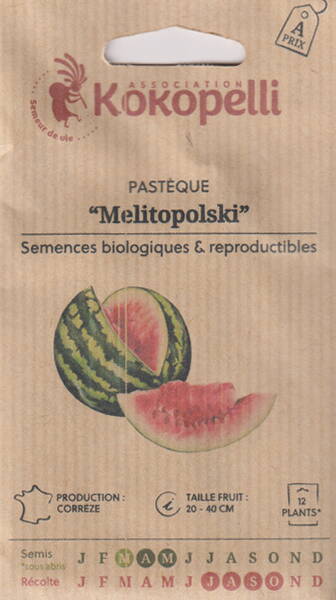
Watermelon “Melitopolsky” — Citrullus lanatus.
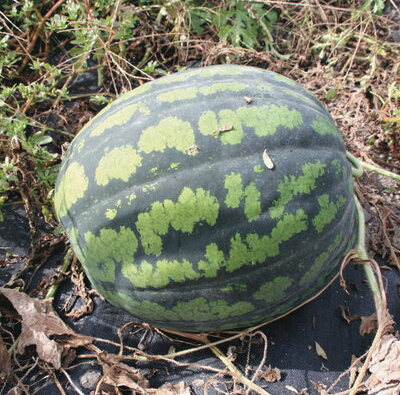
This early-maturing variety produces oval fruits measuring 20 to 40 cm with striped skin, decorated with alternating light green and dark green stripes.
Inside lies a delightful bright red flesh — tender and very sweet. The seeds are red-brown.
Fruit weight: 3000 — 5000 g.
Main vine length: 100 — 200 cm.
Foliage: dissected.
This early-maturing variety produces oval fruits measuring 20 to 40 cm with striped skin, decorated with alternating light green and dark green stripes.
Inside lies a delightful bright red flesh — tender and very sweet. The seeds are red-brown.
Fruit weight: 3000 — 5000 g.
Main vine length: 100 — 200 cm.
Foliage: dissected.
* History: An old heirloom variety originating from the Volga region — an area in Russia famous for centuries for its traditions of growing outstanding melons and watermelons.
Thanks to the unique climate of this region, the variety has acquired an enviable unpretentiousness and the ability to accumulate sugar even during a moderate summer, making it a real treasure for gardeners in northern latitudes.
Agrotechnics.
Sowing for seedlings in early May. Planting seedlings in open ground in late May — early June, in the phase of 3—4 true leaves.
Watermelons are grown in open ground and greenhouses, on light, air- and water-permeable soils. In southern regions, it can be grown by direct sowing in the ground in April — May, when the soil warms up to a depth of 8—10 cm to +15—16 °C. Planting scheme 140×100 cm.
When grown under film covers, the planting scheme is 70×70 cm, and the plants are formed into one stem (all side shoots are removed up to a height of 50 cm, the subsequent ones are pinched over the 1st—3rd leaf), tied to a trellis (fruits can be suspended in nets).
Before sowing, the seeds are treated in a solution of potassium permanganate, then washed with clean water. A seedling method of cultivation is also used. In this case, seedlings are planted after the last frost at the age of 3—4 true leaves. As the plant grows, it is formed into one stem, removing side shoots and leaving 2—3 ovaries on it (the rest are removed).
Further care consists of moderate watering, loosening, feeding, and dusting the vines with soil to protect them from being turned over by the wind.
* DO NOT OVERWATER.
Watermelons in a greenhouse are grown only vertically — the vines are tied to the greenhouse supports, distributing them in such a way as to avoid the slightest shading of the plants.
Watermelon is a drought-resistant crop, so light watering about once every 7—10 days with warm water is sufficient. At the same time, the root collar zone should be protected due to the danger of root rot.
During the fruit ripening period, watering is stopped — this accelerates the ripening process and makes the watermelons sweeter.
Particular attention must be paid to the air humidity in the greenhouse, remembering that watermelons prefer dry air.
To avoid condensation, which leads to fungal diseases, use a well-ventilated polycarbonate greenhouse and limit watering.
FOR SWEET FRUITS...
Feed periodically with complex fertilizers rich in potassium, magnesium, and boron. Maximum nutrient uptake occurs during fruit filling.
It is extremely important to manually pollinate all female flowers (this procedure should be carried out early in the morning) — in a closed greenhouse, you should not rely on natural pollination by insects.
SHAPING AND HARVESTING.
Pinch side shoots carefully. Leave 2—4 fruits per central stem. Do not forget to support the hanging fruits with nets tied to the trellis.
Harvest carefully: watermelons do not ripen after picking. Look for a drying tendril near the fruit stem as a sign of maturity. Store at around +12°C.